|
Cunxi (Jimmy) Dai I'm a Ph.D. student at CMU RI advised by Prof. Guanya Shi. Previously, I was a MSR student advised by Prof. Ralph Hollis, Previous to CMU, I worked with Prof. Zhenzhong Jia, Prof. Mingming Zhang at SUSTech and Prof. Hugh Herr at MIT Media Lab. I care about robots 🦾 that physically interact with the world and assist humans 👫 in all sorts of ways. My research aims to make contact scalable — developing algorithms and data pipelines that let robots master contact-rich interaction, from humanoid loco-manipulation to dexterous manipulation, and adapt intelligently to real-world uncertainty. Email / CV / Google Scholar |
|
News
- 🎉2026.9: Finished a wonderful internship at Amazon Frontier AI & Robotics (FAR)!
- 🎉2025.8: Starting my Ph.D. after a wonderful summer interning at Dexmate!
- 🎉2025.2: Paper on Bi-Level MPC wall-pushing accepted to ICRA 2025, Atlanta:D.
- 🎉2024.10: Paper Selected as Best Papaer Finalist in Mobile manipulation at IROS 2024!
- 🎉2024.6: Paper accepted to IROS 2024 as Oral Presentation.
- 🎉2023.8: I will join CMU Robotics Institute as a graduate student!
- 🎉2023.4: Finished SWheg series robots, marked a mile-stone for a 2-year long project!
- 🎉2022.5: Finished incredible time at MIT MechE as a special student.
- 🎉2022.2: Paper selected as Best Paper Finalist at ICARM 2022.
Research
|
|
CARD: Contact-Anchored Retargeting for Dexterous Manipulation
Cunxi Dai, Botao He*, Francois R. Hogan*, Wei Pan*, Rao Fu, Wen-Han Hsieh, Ruoshi Liu, Jitendra Malik, Guanya Shi, Akash Sharma CoRL Scaling H2R Workshop, 2026 arXiv / webpage TL;DR: CARD is a simulator- and object-free framework that retargets human demonstrations to robot actions by explicitly preserving contact force targets, unifying video, motion capture, and tactile-glove data through a shared hand-contact representation. |
|
Trajectory Planning without Trajectory Data: A Manifold-Guided Approach
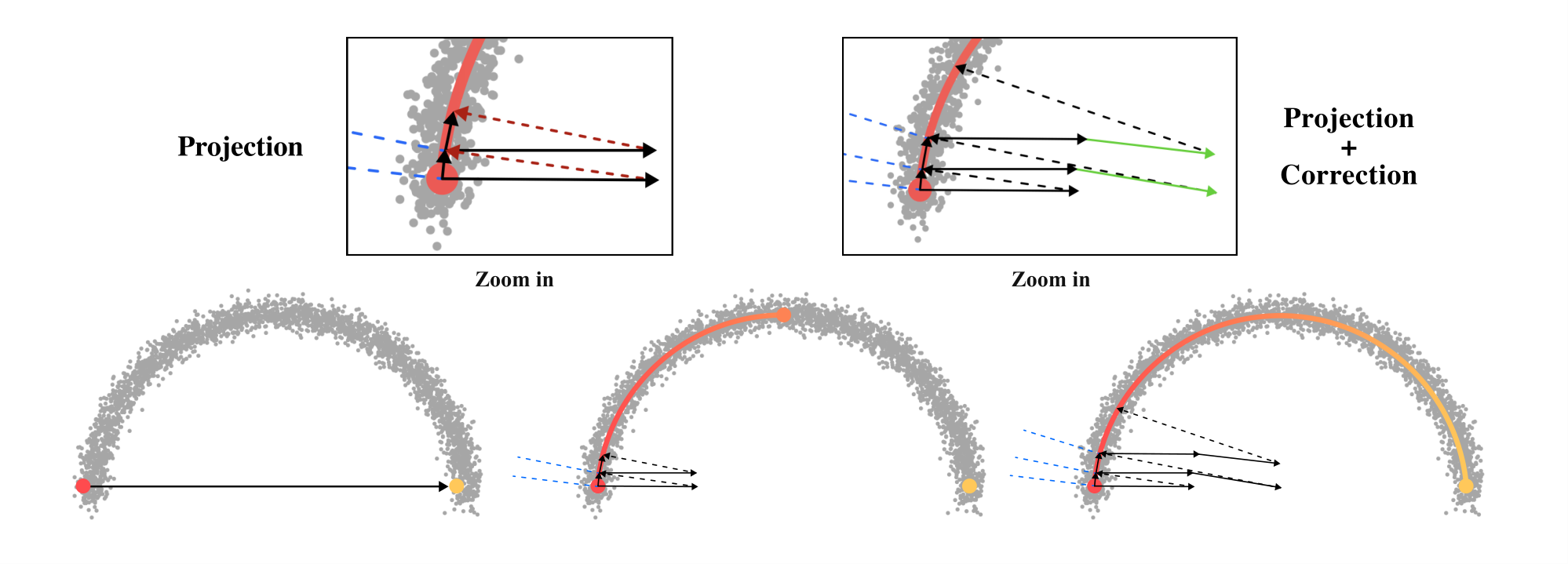
Silong Yong, Anji Liu, Cunxi Dai, Carl Busart, Guanya Shi, Yilun Du, Katia Sycara, Yaqi Xie arXiv preprint, 2026 arXiv / code TL;DR: Ariadne learns the underlying state-space manifold from state-only observations and uses its geometry to construct feasible trajectories, generalizing to unseen start-goal pairs without any expert trajectory data. |
|
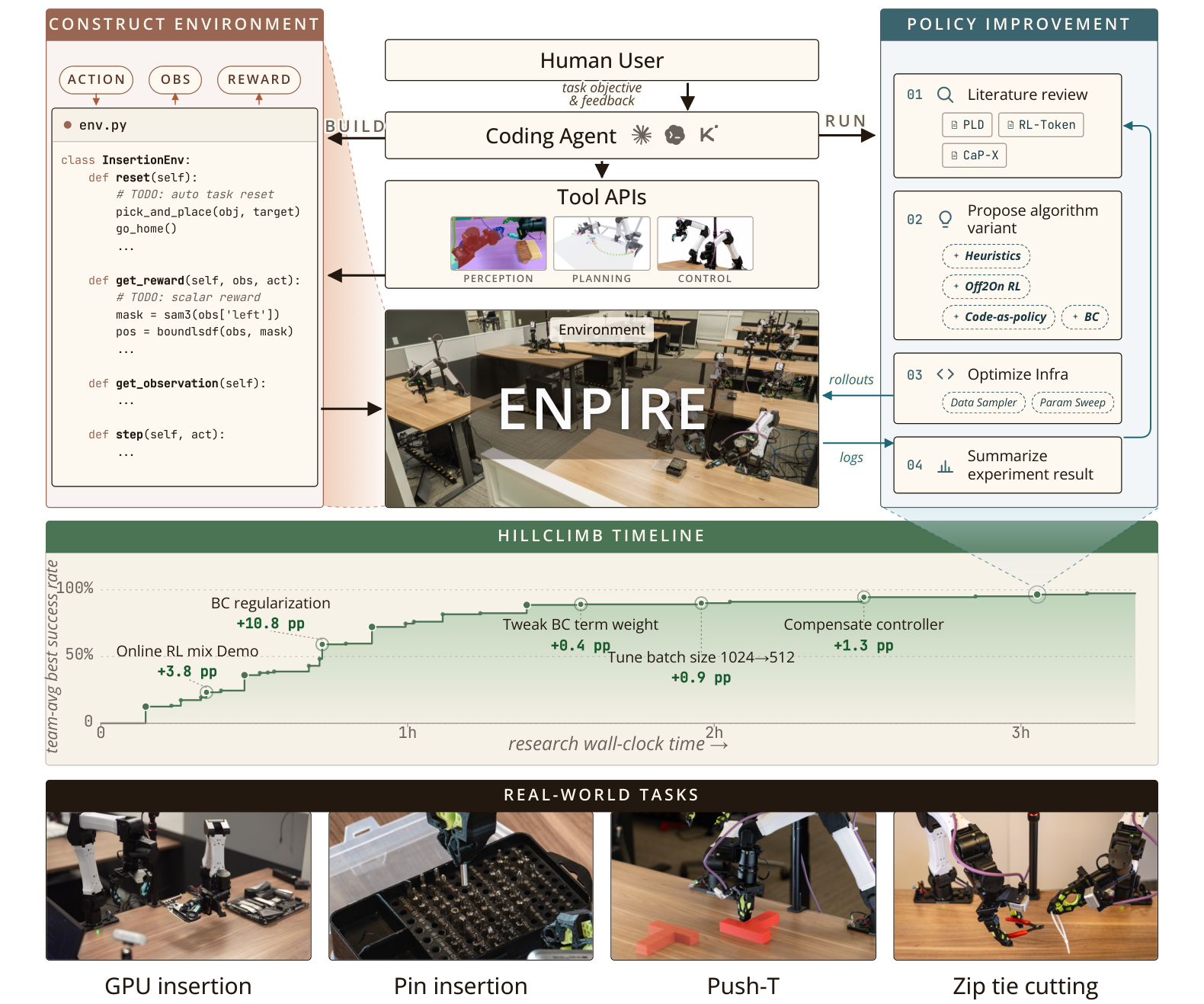
ENPIRE: Agentic Robot Policy Self-Improvement in the Real World
Wenli Xiao, Jia Xie, Tonghe Zhang, Haotian Lin, Letian "Max" Fu, Haoru Xue, Jalen Lu, Yi Yang, Cunxi Dai, Zi Wang, Jimmy Wu, Guanzhi Wang, S. Shankar Sastry, Ken Goldberg, Linxi "Jim" Fan, Yuke Zhu, Guanya Shi CoRL, 2026 arXiv TL;DR: ENPIRE lets coding agents construct real-world robot environments and autonomously iterate on policy improvement, enabling robot policies to self-improve on dexterous manipulation tasks without human algorithm engineering. |
|
|
PGDG: Physically Grounded Data Generation for Robust Bimanual Policy Learning from a Single Demonstration
Cunxi Dai, Haoran Chang, Aditya Nisal, Rahul Kumar, Guofei Chen, Tao Chen, Yuzhe Qin, Guanya Shi arXiv preprint, 2026 arXiv / webpage TL;DR: PGDG is a data generation framework with zero-shot curation that expands a single demonstration into a compact dataset of physically plausible recovery behaviors, enabling robust contact-rich bimanual policy learning. |
|
|
BFM-Zero: A Promptable Behavioral Foundation Model
for Humanoid Control Using Unsupervised
Reinforcement Learning
Yitang Li*, Zhengyi Luo*, Tonghe Zhang$, Cunxi Dai$, Andrea Tirinzoni, Anssi Kanervisto, Haoyang Weng, Kris Kitani, Mateusz Guzek, Ahmed Touati, Alessandro Lazaric, Matteo Pirotta, Guanya Shi ICLR, 2026 arXiv / webpage TL;DR: BFM-Zero is a behavioral foundation model that learns a shared latent space over motions, goals, and rewards via unsupervised RL, letting a single humanoid robot policy be prompted to perform diverse whole-body tasks in the real world. |
|
|
Interactive Navigation with Adaptive Non-prehensile Mobile
Manipulation
Cunxi Dai*, Xiaohan Liu*, Koushil Sreenath, Zhongyu Li, Ralph Hollis RA-L, 2025 arXiv / webpage TL;DR: A holistic framework for dynamic interactive navigation that leverages learned representations for rapid adaptation to object dynamics, and utilizes model-based prediction to inform decision-making. |
|
|
Wallbounce : Push wall to navigate with Contact-Implicit MPC
Xiaohan Liu*, Cunxi Dai*, Roberto Shu, John Z. Zhang, Arun Bishop, Zachary Manchester, Ralph Hollis ICRA, 2025 webpage TL;DR: A bi-level MPC framework that enable non-preodic upper-body contact to achieve more agile locomotion. |
|
|
Wheelchair Maneuvering with a Single-Spherical-Wheeled Balancing Mobile Manipulator
Cunxi Dai*, Xiaohan Liu*, Roberto Shu, Ralph Hollis IROS 2024, Oral Presentation Best Paper Finalist in Mobile Manipulation, IROS 2024 arXiv / YouTube / New Scientist / Video Friday TL;DR: Wheelchair maneuvering with Ballbot that balance on a single-spherical wheel. |
|
|
SWheg: A Wheel-Leg Transformable Robot With Minimalist Actuator Realization
Cunxi Dai*, Xiaohan Liu*, Jianxiang Zhou*, Zhengtao Liu, Zhenzhong Jia in submission to Journal of Field Robotics (JFR) arXiv / YouTube TL;DR: Minimalist actuator realization of a wheel-leg transformable robot with tendon-driven transformation wheel module. |
|
|
Swhegpro: A novel robust wheel-leg transformable robot
Cunxi Dai, Xiaohan Liu, Zhenzhong Jia ROBIO 2023 Paper / YouTube TL;DR: Robust design of a wheel-leg transformable robot for high-payload context. |
|
|
Human-Exoskeleton Misalignment Reduction on Knee Joint via an RPR Mechanism-Based Device
Cunxi Dai, Peiwen Fu, Bin Zhong, Kaiqi Guo, Mingming Zhang ICARM 2022 Best Paper Finalist, ICARM 2022 Paper / YouTube TL;DR: Knee joint misalignment reduction with an RPR mechanism-based device. |
Selected Projects |
|
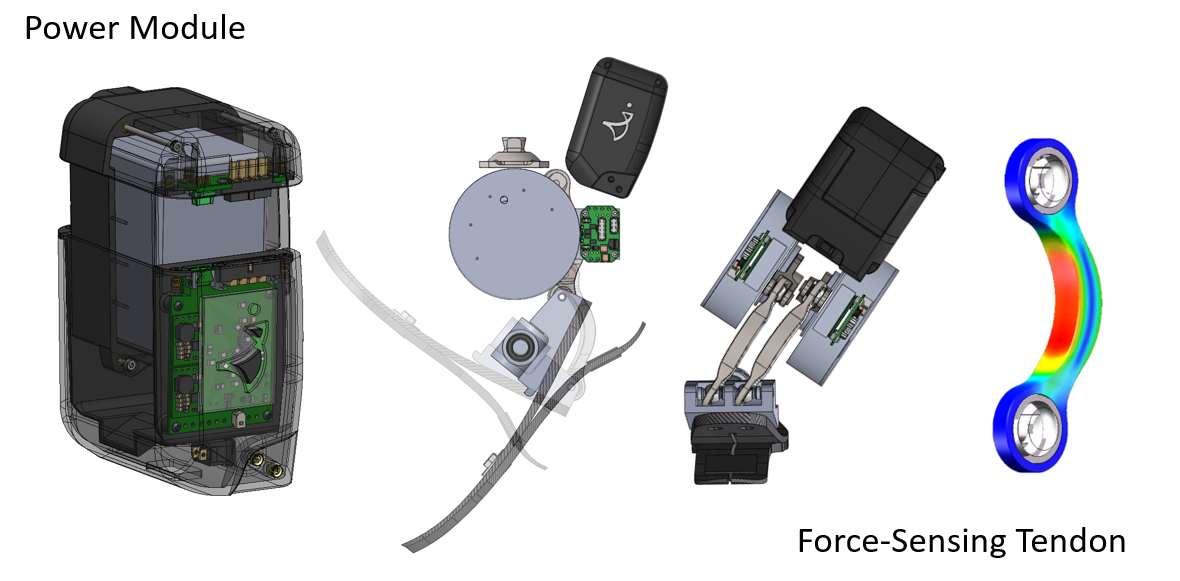
Power Management Module and Force-Sensing Tendon for 2-DoF Ankle-Foot Prosthesis
MIT Media Lab, Biomechatronics Lab, 2023 |
|
Template from Jon Barron. |